Something is happening in the world of layout control software. For years, the choice was more or less between a handful of well-established programs… and now new ones seem to pop up, many of them developed with the help of AI. As a TrainController user, I find this fascinating, so here is my take on where the market stands and where it may be going.
Credit where credit is due: this article was directly inspired by a discussion on the German forum 1zu160.net, under the lovely title “MoBa-Apps wachsen wie die Schwammerln im Herbst?” (roughly “Are model railway apps popping up like mushrooms in autumn?”, Schwammerl being the Bavarian and Austrian word for mushroom). Enthusiasts, sceptics and developers all chimed in, and several of the points below were first raised there. A second thread presents LoDi-Aura, which I talk about below. Both are well worth a read if you understand German (or have a good translation tool).
Some notes beforehand:
- I have not yet tested any of the new solutions below. Everything is based on the makers’ websites, project pages and forum discussions at the time of writing, in November 2026. This moves very fast: if you read this later, things have probably changed.
- Many users seem satisfied with these new programs, but it is early days for all of them.
- The rest is personal opinion, based on my own experience and readings.
- This article will become outdated very quickly, so take it with a grain of salt if you read it 6 months+ after it was published.
Where I’m coming from: TrainController 11 Gold
Like many of you, I have been running my layout with TrainController for a long time (I was already writing about train identification with TrainController and MARCo in 2013), currently version 11 Gold with my ESU ECoS II. And I am still using it today: for me, it remains the best software for my needs, both for its functions and for its nice interface.
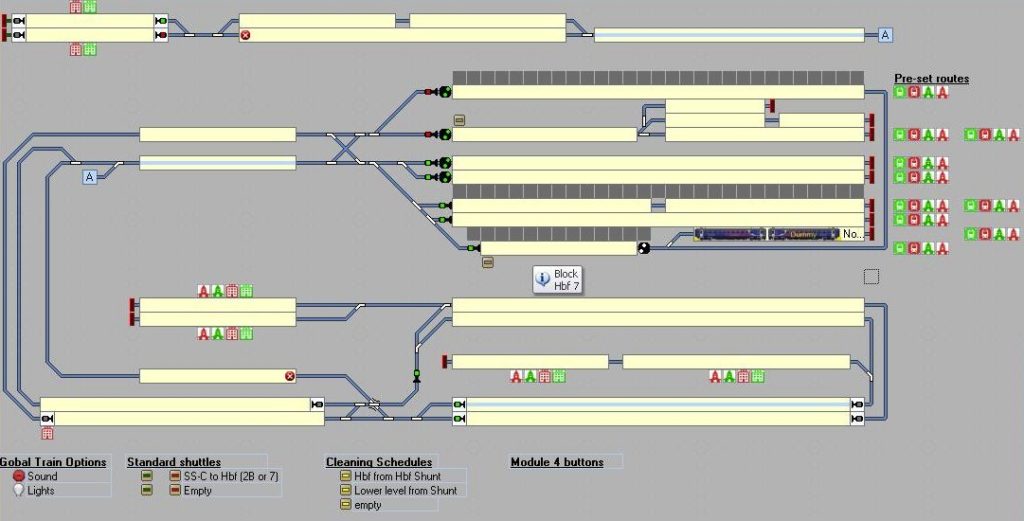
Freiwald Software stopped selling TrainController on 30 June 2026 and ended its business. Licences bought before that date remain valid, but the software is not maintained anymore, and version 10 and 11 licences depend on Freiwald’s licence servers. What will happen to those servers in the long run has been communicated in a rather… laconic way, to put it politely: a future change of licensing method was mentioned for version 11, without any details.
So my layout runs fine today, and I’m not planning to switch while it does, but it may refuse to start any day if those servers go down. Not a comfortable position, that’s been debated in many model train forums in the last months.

The established alternatives, and why I hesitated
So I did what many TrainController users did: I looked at the alternatives. And there are still many good options on the market.
iTrain (by Berros) is probably the closest to TrainController in its philosophy. It is now at version 6, runs on Windows, Mac and Linux, and costs from €139 (Lite) to €399 (Professional). Its developer is extremely active, friendly and efficient, honestly an example in this hobby. But as far as I know, he is alone… and that is exactly the problem we now have with TrainController: when a one-person project stops, everything stops.
Win-Digipet is the opposite: a team, more than 40 years of development, and an extremely rich software. I tested the 2025 version. And here I want to be careful, because I have a lot of respect for the work behind it, but to be honest, the interface really feels like it comes from the 1990s to me. It is a software made by engineers for engineers (regular readers know I say the same about Zimo, and that the engineering part is a compliment!), and in my opinion it is just not adapted to how we use computers today. Again, this is purely my personal taste, and I know many happy users will disagree.
JMRI is a special case. I have personally never used it to control a layout, partly because, again, I find its interface a bit dated. But it is free and open source, and it runs on PC, Mac and Linux. And its decoder programming part, DecoderPro, remains the one go-to tool to program decoders. I think it will stay that way, simply because its community is unbeatable: according to the project, about 50,000 hobbyists use JMRI and more than 300 developers have contributed to it over 25 years. I modestly contribute decoder definitions myself, including for Zimo and Doehler & Haass.
A new generation is arriving
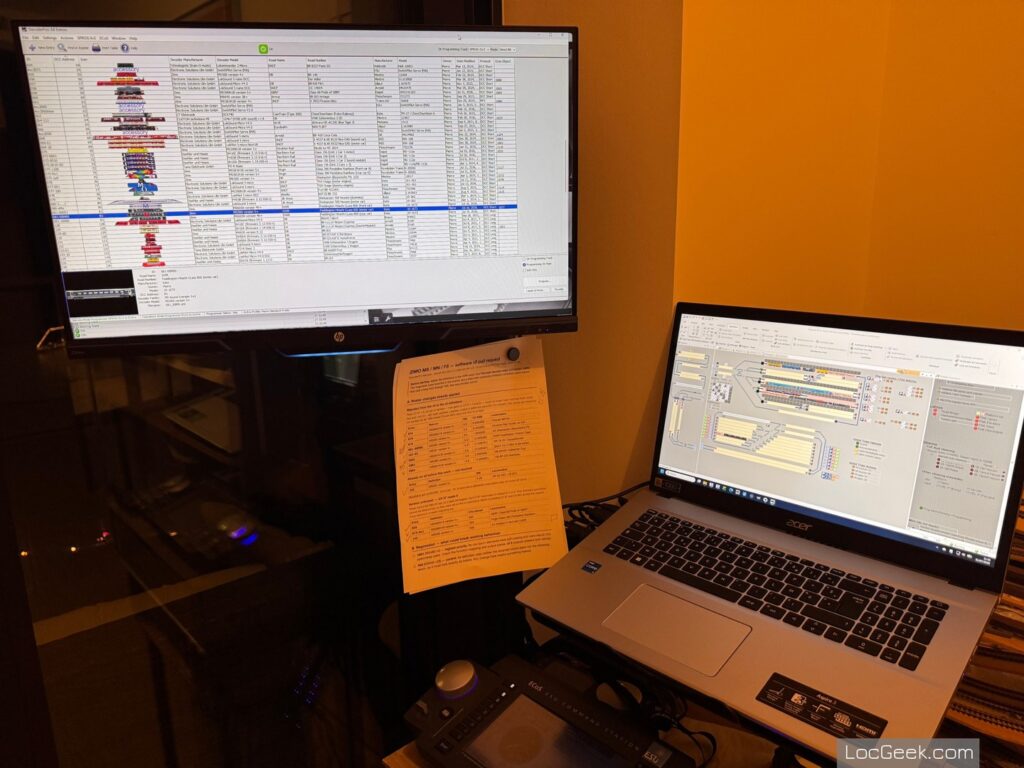
And then, this autumn, things started to move. Here are the ones that caught my eye (again: not tested!).
LoDi-Aura, by LokStoredigital (the makers of the LoDi command stations and modules), is to me the most significant one: it is the first commercial product of this new generation, and it comes from an established hardware manufacturer. The first release is planned for 15 November 2026, and pre-orders are open. It runs on Windows, macOS and Linux, with a browser-based interface, so other computers and tablets on your home network can drive too. It works with LoDi hardware, plus Märklin CS2/CS3, ESU ECoS, Roco/Fleischmann Z21 and Lenz XpressNet. With LoDi devices, the basic functions are free; otherwise licences cost €199 (Basic), €299 (Standard, with automatic running) and €399 (Professional), “one-off per version”. Third-party command stations cost €49 each, unless you take the Professional licence, which includes them all. Licences are activated online, and according to an answer on the LoDi forum, one licence can be activated on three devices. One feature I find clever: the automatic calibration of the locomotives’ speed.
LocoLink 2.0 says it supports more than 45 command stations, runs on Windows, Mac and Linux plus native iPhone and iPad apps, and is sold either as a monthly or yearly subscription or as a one-time purchase, with a 30-day trial. It is openly marketed at TrainController users. I could only find the maker’s own information about it, so take this with a pinch of salt.
On the open source side, Traintastic (GPL licence, developed in spare time since 2019) supports a wide range of command stations and runs on Windows and Linux. Automatic driving and timetables are not there yet, and the project itself says it is not a full-featured product yet, but it is one to watch.
TrainMaster, presented on 1zu160, is MIT-licensed open source. It runs as a small server on Windows or Mac with a browser interface, and supports Z21-compatible command stations and DCC-EX, with its own ESP32-based hardware for occupancy detection and turnout servos. Still very young.
And then there are all the personal projects. On Stummiforum, a member described his own timetable-driven control for his H0 module layout: a Mac app talking to a Z21, with iPads and phones as displays, station announcements and even an automatic mode that learns from his manual runs… all written by Claude over a weekend, without him writing a single line of code. It is not published, but it shows what is now possible.
| Software | Runs on | Licence / price | Command stations |
|---|---|---|---|
| LoDi-Aura | Windows, macOS, Linux (browser interface) | Paid: €199 to €399 per version (basic use free with LoDi devices) | LoDi, Märklin CS2/CS3, ESU ECoS, Z21, Lenz XpressNet |
| LocoLink 2.0 | Windows, Mac, Linux, iPhone, iPad | Paid: subscription or one-time purchase | 45+ (maker’s claim) |
| Traintastic | Windows, Linux | Free, open source (GPL) | Wide range |
| TrainMaster | Windows, Mac (browser interface) | Free, open source (MIT) | Z21-compatible, DCC-EX |
| iTrain 6 | Windows, Mac, Linux | Paid: €139 to €399 | Many |
| Win-Digipet 2025 | Windows | Paid | Many |
| JMRI 5.16 | Windows, Mac, Linux, Raspberry Pi | Free, open source | Very many |
| TrainController 11 | Windows | No longer sold (since 30 June 2026) | Many |
Software development has changed, and that’s not a bad thing
I work in technology, and I can tell you: software development has changed completely in the last two years. Developers use AI, every day. Let’s be realistic: someone who makes model train software today and does not use AI is going to lose to those who do.
This is what makes this new generation so interesting. As far as I can see, LoDi-Aura doesn’t say so anywhere, and I may be wrong, but it really looks to me like it was developed with the help of AI. That is not bad at all in itself: it is simply how software is made now. “New generation” is almost another way of saying “developed with AI”. And it shows: these programs are still young, but they are already quite powerful, even if they are sometimes limited in the hardware they can connect to.
Open source or paid: both are here
What I find fascinating is that this new generation comes in both flavours. On one side, open source projects like Traintastic or TrainMaster (and of course JMRI, which has been there for 25 years). On the other, LoDi-Aura, the first commercial one… which is priced just like the previous generation: €199 to €399, when iTrain goes from €139 to €399. So AI-assisted development doesn’t mean cheaper software, at least not yet.
Another trend: hardware manufacturers using software to sell their hardware. LoDi-Aura is free for basic use with LoDi devices, and charges extra for third-party command stations. Rocrail took yet another path years ago: open source until 2015, then freeware with a paid “support key” for the extra features.
Which model will win? Honestly, I don’t know, and I’m very curious to see how this evolves.
PC, Mac… and even Linux
One very practical thing about most of these new solutions: they work on PC and Mac, sometimes Linux, often with a browser interface on top so you can drive from a tablet. The older generation, TrainController and Win-Digipet, are purely Windows programs, which in my opinion is just not adapted to today’s computer market anymore. Windows is still dominant on desktops, but Macs and even Linux are now often used as work or home PCs. The market is a lot more diverse than when these programs were born.
Do we even need ready-made software anymore?
Now here is the question that really intrigues me. With an AI model like Claude Opus 5.5, still a very powerful model at the time I am writing this (a sentence that will become outdated very quickly!), someone with medium-plus knowledge of AI can develop a basic control software for their own layout at home, with a subscription of around €20 a month. The Stummiforum example above proves it. I am not recommending it: you need to be a bit technical, and you will have to maintain it yourself. But it is completely possible.
So it is the same question as for every piece of software today: will people with a very specific train control need still buy a complex open source or paid solution, when they can build exactly what they need at home? Such a program would be purely local, never accessible from the internet, so security issues and patches are much less of a concern.
For a small layout with simple needs, I think that is a real alternative. For a large layout with complex automation, I’m less sure: as someone pointed out in the 1zu160 discussion, the real work is often entering your layout into the software, not the software itself.
A less pleasant threat for existing vendors
There is another side to all this. AI has also become very good at defeating software keys and copy protection, and from what I gather, some users have managed to do exactly that with TrainController. I don’t condone it, and I won’t link to anything, but it is a reality the existing vendors will have to face: licence protection, which has been the basis of commercial software for decades, is much weaker than it used to be. And for users, the TrainController story is also a reminder that a licence relying on the vendor’s servers is a risk in itself.
There is also the business model question: traditional train control software uses the old principle, buy once, use forever (and pay a fee for version upgrades if they arrive). But we all know everything is a subscription now, and some newer solutions offer this too: LocoLink, for example, is sold as a monthly or yearly subscription, next to a one-time purchase. Not something users like. Also maybe not adapted for people who may not actually use their model train (software) for several months in a row.
My take: let’s watch what will happen
So where does that leave me? Curious, and rather positive. For years, layout control software felt like a small, frozen market, and suddenly there is competition, new ideas, Mac and Linux support, and both open source and commercial options. That can only be good for us.
The big question for all these new projects was also raised in the 1zu160 discussion: will they still be maintained in five years, and can a single developer (even with AI) support hundreds of users? Each project is also its own little world, with no shared interfaces between them… and if you have been reading this blog for a while, you know fragmentation is my favourite complaint. It will be very interesting to see who is still here in two or three years.
One needs to remember that configuring a layout, dozens of points, trains, automations represents days or even weeks of configuration on a new piece of software.
Have you tried any of these new programs? Are you a TrainController user too, and what is your plan? And would you build your own control software with AI? Let me know in the comments.
As always, this is just my personal opinion, based on the information available in November 2026, and I am always open to changing my mind with a smile and the right arguments!