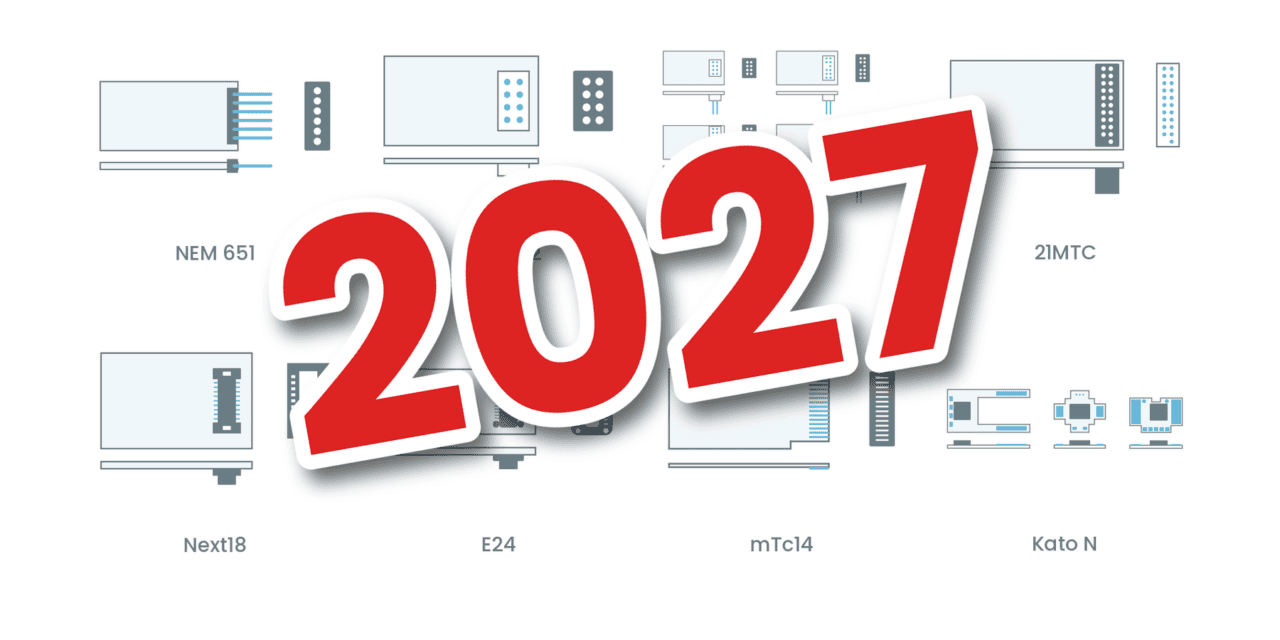
There have been a few novelties in digital interfaces lately, especially with E24 now spreading in the small scales. So I thought it was time for a quick update on the decoder plugs you will actually find on the market heading into 2027: what they are, where they are used, and what they offer.
If you have been following this blog for a while, you know this is not the first time I talk about this topic… I first complained about the mess back in 2012 with my DCC plugs overview (yes, they’ve gone crazy), then wondered in 2014 if Next18 would be N scale’s future, and more recently got (a bit) worked up about E24, yet another confusing digital interface.
Things have moved since then, so here is where we stand today.
Some notes beforehand:
- This is not an exhaustive list: only the most common interfaces, and no large scales (1, G…).
- The technical data (contacts, outputs, decoder size) comes from the official standards. Most interfaces are defined by up to three bodies: MOROP in Europe (the NEM norms), the NMRA in North America (S-9.x), and RailCommunity, a manufacturers’ association (RCN). This is why they are often simply called by their NEM number.
- “Adoption” is my own assessment, based on what I see on the market, not on market studies. Same for the scales: those are the most common ones, which doesn’t exclude some models in other scales.
- The diagrams are my own drawings and are not to scale. They are only meant to give you an idea of the shape of each plug, on the decoder and on the locomotive side.
The main interfaces at a glance
| Interface | Scales | Adoption | Pins | Outputs |
|---|---|---|---|---|
| NEM 651 | N | 6 | 2 | |
| NEM 652 | HO | 8 | 2 | |
| PluX8 | – | 8 | 2 | |
| PluX12 | N | 12 | 4 | |
| PluX16 | HO, TT | 16 | 6 | |
| PluX22 | HO, TT | 22 | 11 | |
| 21MTC | HO | (1) | 21 | 12 |
| Next18 | N, TT | 18 | 6–8 | |
| E24 | N, TT | 24 | 13 | |
| mTc14 | N | (1) | 14 | 6 |
| Kato N | N | (2) | – | varies |
Scales: scales most commonly used in, but this doesn’t exclude the use in some models in other scales. Outputs: total number of outputs for lights and functions. Some outputs can be logical outputs, which means they are low voltage/power and need some additional electronics to be actually connected to a light or other functions.
Adoption: widespread spreading declining rare, or one brand only.
(1) Märklin/Trix. (2) Kato N scale, but not always.
NEM 651, the old N scale classic
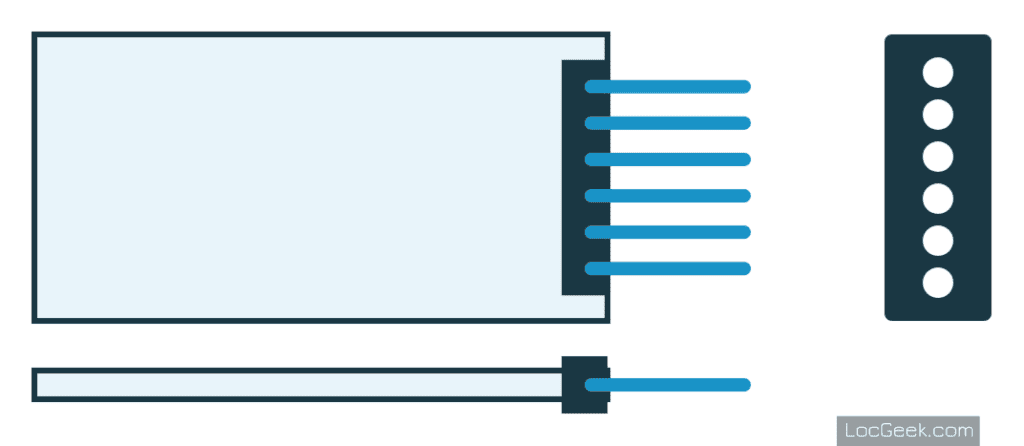
The one you will still find in a lot of N scale models. It does the job, but it is quite outdated: only 2 lighting outputs, and no contacts for a speaker. It is slowly being replaced by Next18 or E24.
Introduced: 1997 (estimated, no official date)
Common in: mostly N
Contacts: 6, in one row (1.27 mm pitch)
Outputs: 2, no speaker contacts
Decoder size in the standard: 20 × 10 × 4 mm (space for a non-sound decoder)
Standards: NEM 651 · NMRA S-9.1.1.1
NEM 652, the HO veteran
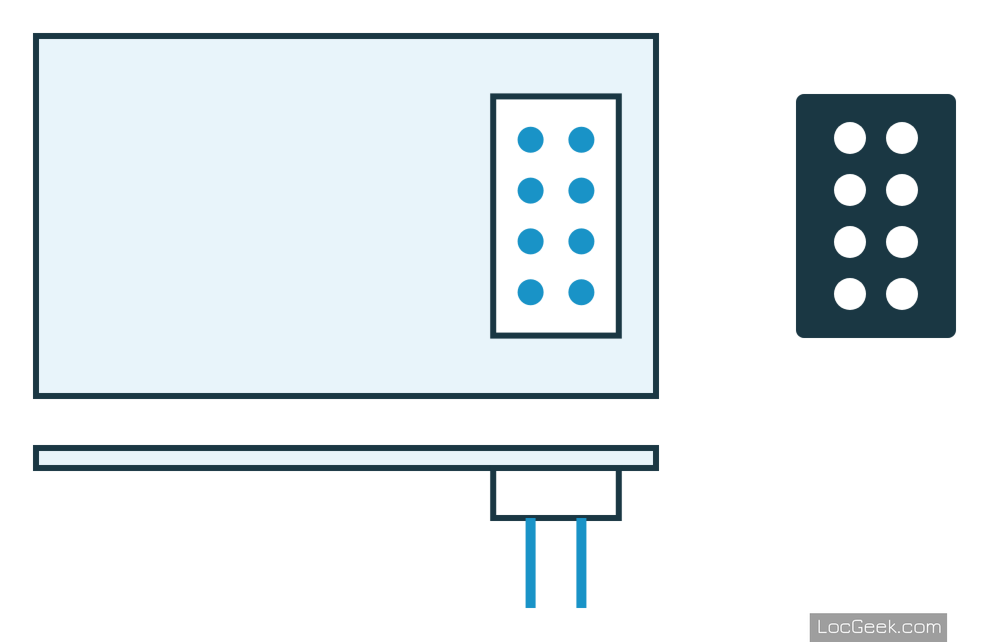
The big brother of NEM 651, for HO. It has been quite common for years, but it is just as outdated, with only 2 lighting outputs here too. It is slowly being replaced by the more modern interfaces below.
Introduced: 1995 (estimated, no official date)
Common in: mostly HO
Contacts: 8, in two rows of 4 (2.54 mm pitch)
Outputs: 2, no speaker contacts
Decoder size in the standard: 31 × 18 × 7 mm (space for a non-sound decoder)
Standards: NEM 652 · NMRA S-9.1.1.1
PluX (NEM 658), the (mostly) HO family
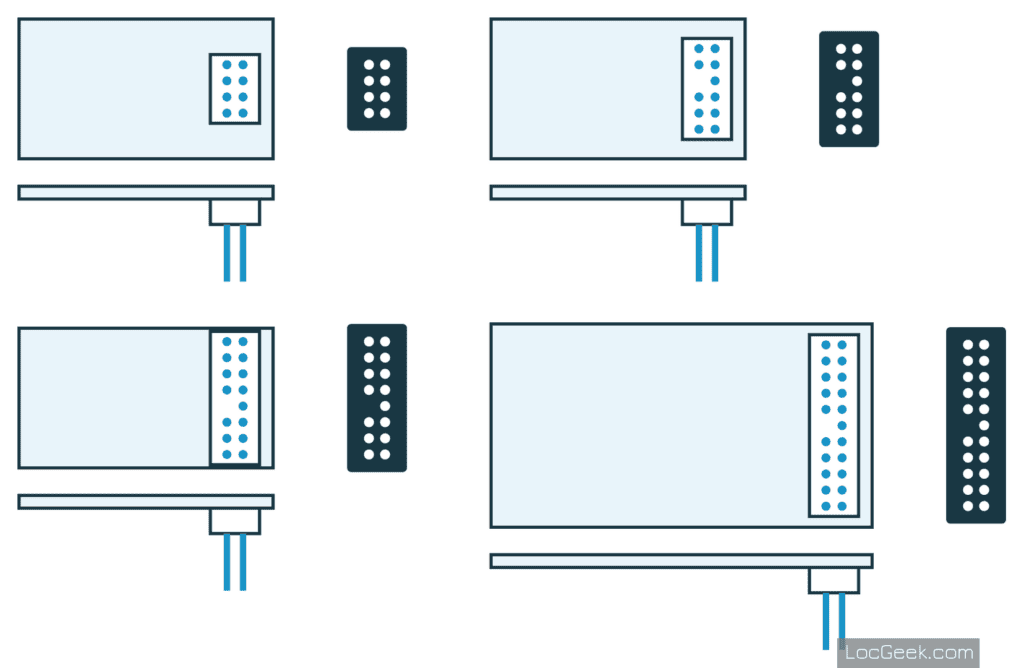
PluX is not one plug but a family, named after its number of positions: PluX8, PluX12, PluX16 and PluX22. One of these positions is an index (a missing pin), so the decoder can only go in one way.
PluX22 is the most common in HO, and is still very much an up-to-date interface. PluX8 is the smallest, but offers only 2 lighting outputs and has hardly ever been used: it is not even in the current standards anymore. PluX12 is still sometimes used in N scale in Europe (mostly by Piko), a choice that is not very appreciated by the community, since it is an old and limited standard.
Introduced: 2008
Common in: mostly HO, sometimes N and TT
Standards: NEM 658 (PluX12, PluX16, PluX22) · NMRA S-9.1.1.4 and RCN-122 (PluX16 and PluX22)
- PluX8: 8 positions (including the index), 2 outputs, no speaker contacts. Dropped from the current standards.
- PluX12: 12 positions, decoder 20 × 11 mm, 4 outputs, speaker contacts. RCN-122 only covers it in an annex.
- PluX16: 16 positions, decoder 20 × 11 mm, 6 outputs (4 power, 2 logic level), speaker contacts.
- PluX22: 22 positions, decoder 30 × 16 mm, 11 outputs (9 power, 2 logic level, plus GPIO_C), speaker contacts.
21MTC (NEM 660), the Märklin/Trix version
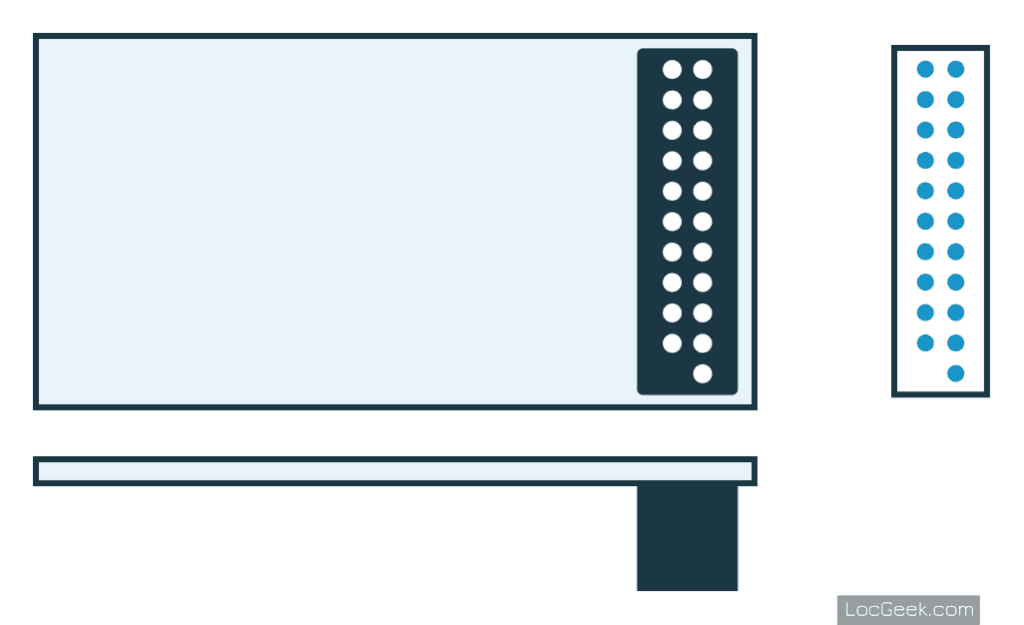
Very common in HO, used by Märklin and Trix. Lots of outputs on paper, but most of them are logic level outputs: they are low power, and need some extra electronics on the locomotive’s board to actually drive a light or a function.
Introduced: 2005
Common in: mostly HO
Contacts: 21 (plus the index position)
Outputs: 12 (4 power, 8 logic level), speaker contacts
Decoder size in the standard: 30 × 15.5 mm
Standards: NEM 660 · NMRA S-9.1.1.3 · RCN-121
Next18 (NEM 662), the N scale standard (for now)
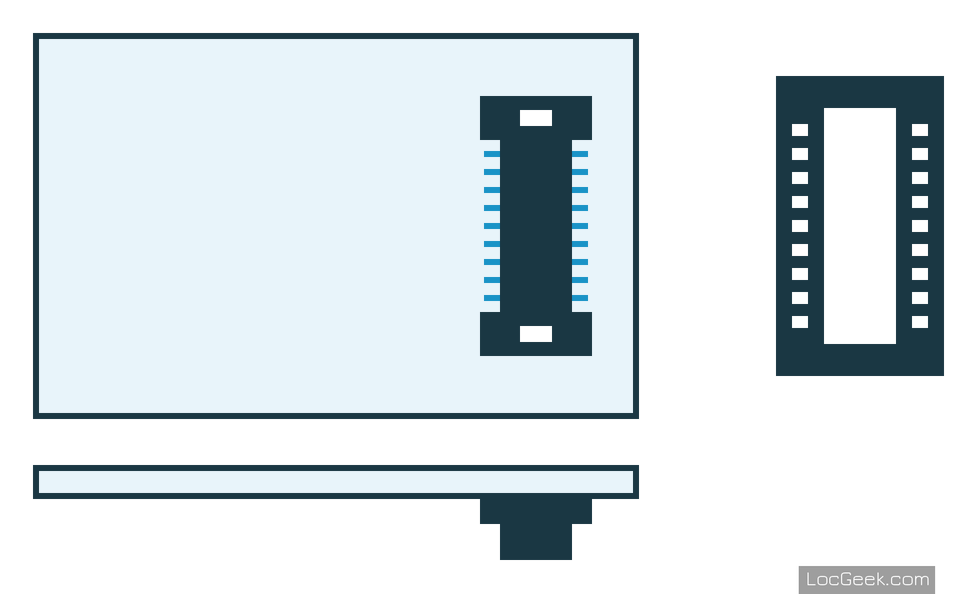
The one I was hoping would become N scale’s future back in 2014… and it did, at least for a while. Next18 has become very common in N scale since its introduction, and is also used in TT, and sometimes even in small HO engines. It is a good compromise between size and number of outputs. Its sound version, Next18-S, swaps two logic outputs for speaker contacts.
It is still a very valid interface. However, it is slowly being replaced by E24, which is technically better and more future-proof.
Introduced: 2011
Common in: N, TT and small HO locomotives
Contacts: 18
Outputs: 8 (4 power, 4 logic level); Next18-S: 6 (4 power, 2 logic level) plus speaker contacts
Decoder size in the standard: 15 × 9.5 mm
Standards: NEM 662 · NMRA S-9.1.1.5 · RCN-118
E24 (NEM 664), the ambitious newcomer
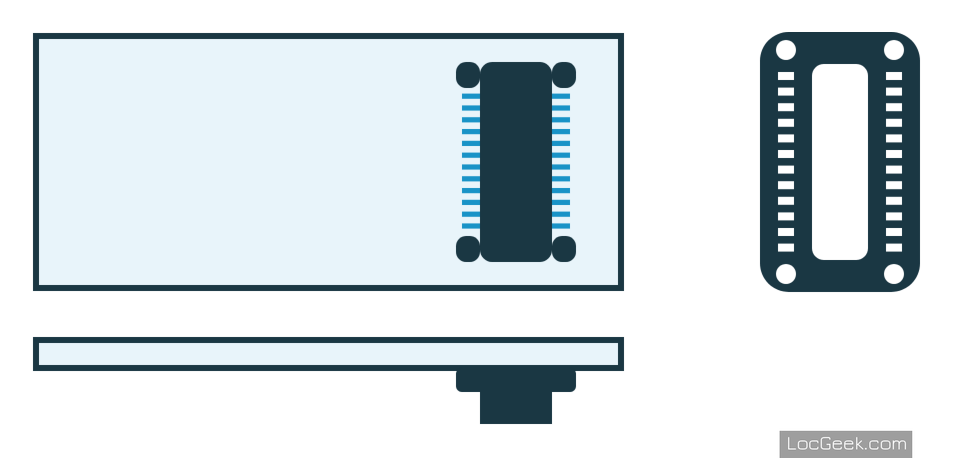
The main reason for this update. E24 was introduced around 2020 by ESU for their LokSound Nano range, as a contender to replace Next18… at the very moment Next18 was slowly becoming the standard in N scale. You may know I wasn’t thrilled at the time, and I would have been happy to see Next18 settle as the standard.
You may also have seen it called Next28. That name doesn’t seem to be used much, and that’s a good thing: it would only add confusion with Next18!
But I have to admit E24 does bring more: more outputs, and things like provision for on-board capacitors. So although it adds yet another standard, it is a valid trade-off. It is now a proper NEM norm, European manufacturers are slowly adopting it, and most decoder manufacturers already produce E24 decoders. I think it is likely to become the new standard in the next few years.
Introduced: around 2020 (estimated, no official date)
Common in: N, TT and small HO locomotives
Contacts: 24 (plus 4 corner guide pins)
Outputs: 13 (8 power, 5 logic level), speaker contacts
Decoder size in the standard: 19.5 × 8.4 × 2.6 mm
Standards: NEM 664 · NMRA S-9.1.1.6 · RCN-124
mTc14, the Minitrix loner
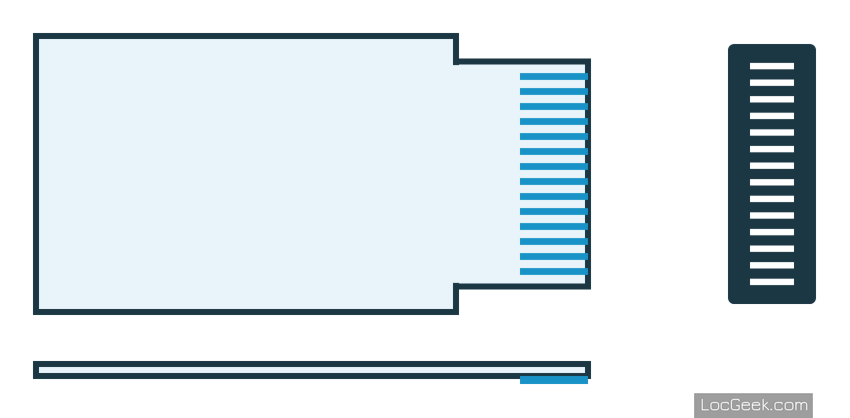
Trix’s own plug, mostly for Minitrix N scale models. RailCommunity did publish it as a standard (RCN-114), but RailCommunity is a manufacturers’ association, and in practice this remains a one-brand interface. It is not much loved by the community: decoders are hard to find (as far as I know, only Minitrix and Doehler & Haass make them), and it is not compatible with any other interface.
Unfortunately, Trix hasn’t adopted a standard either, and seems to be using more and more on-board decoders soldered to the engine, with no interface at all.
Introduced: 2012
Common in: N (Minitrix)
Contacts: 14, flat flexible connector (0.5 mm pitch)
Outputs: 6 (4 power, 2 logic level), no speaker contacts
Decoder size in the standard: 14.0 × 9.2 mm
Standards: RCN-114 only
Kato N, doing its own thing
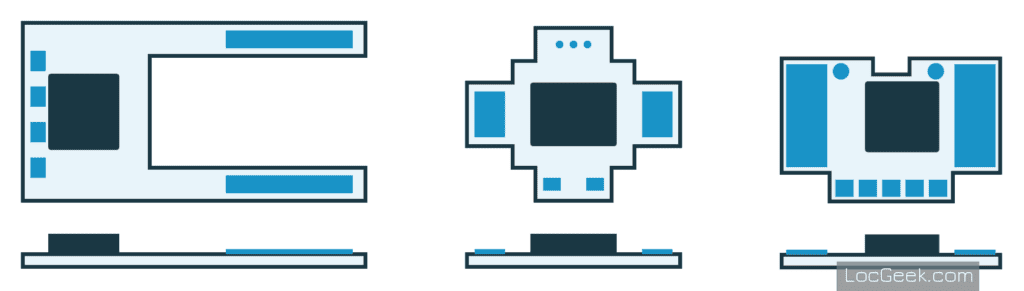
Not really one interface. A few Kato models for the European market come with a NEM 651 plug. American models tend to go for a more extreme method: no interface at all, and the whole electronic board needs to be replaced. The rest of the time, Kato uses proprietary interfaces, with 3 separate decoder types and shapes: motor, headlights, and coach lights.
Introduced: unknown
Common in: N (Kato, but not always)
Contacts: replacement board with contact pads
Outputs: varies, no speaker contacts
Standards: none (proprietary)
Last word
Once again, this overview is not meant to be comprehensive. I focused on the interfaces you are most likely to meet in N, TT and HO, and left the larger scales like 1 and G aside.
If you are in N scale like me, the short version is: Next18 is what you will find the most today, E24 more and more, and NEM 651 on older models. Not that bad… as long as nobody comes up with yet another plug!
All this, with more details, will be in the third edition of my book, which I am planning to release before 2027. But my goal on this blog is not to sell books, it is to share information. This is why you already get all of it here.
So what do you think? Which interfaces do you find in your models, and have you already met E24 in the wild? Also comment if you think I missed something, or got something wrong.